…Rachel R. Hardeman is but one manifestation of that problem.
I started writing this last December after back to back articles centering her were published. I was sick of it. She wreaked havoc on my mental and financial health, along with many others, yet there she was smiling and being praised for her “work.”
I debated whether to publish this. I’ve been waiting on some authority to finally validate the complaints that we’ve been making since September 2023, waiting for someone with status to go public. But this past week, I realized no one was coming, and that the last remaining investigations would close like the first two at UMN over her plagiarism – without consequence. So I went public.
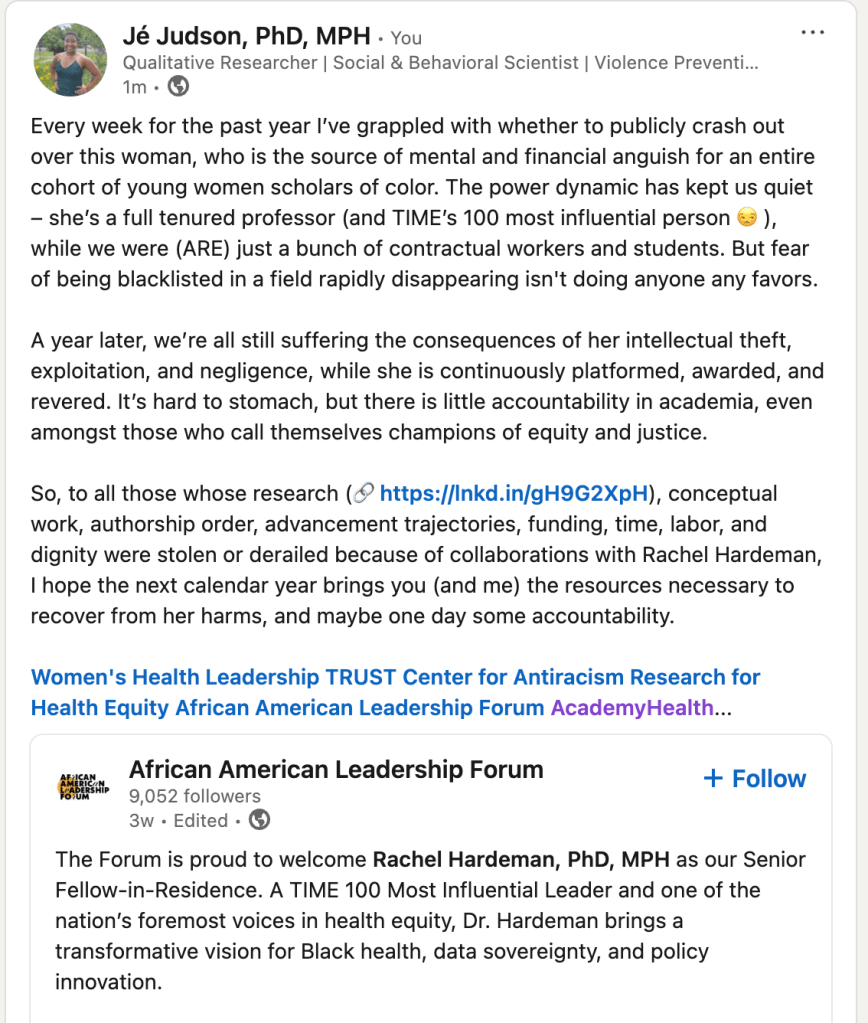
And then my colleague followed suit. And then another. My original post is gone – the organization I reposted removed their post, which deleted mine – but the impact was had. People are outraged about her intellectual theft: Brigette’s case was particularly egregious, but Brittney’s was no less harmful. The plagiarism, however, is just the tip of the iceberg.
There’s an entire other story about how quickly she ran her Center for Antiracism Research for Health Equity (CARHE) into the ground, abusing, exploiting, and neglecting many early career scholars along the way. Most of the staff is gone. Waves of resignations and callous contract terminations have rendered CARHE a research center without researchers or research to do. Yet, the public relations is still in overdrive, promoting the shell of the center’s remnants; recommitting to a murky mission.
While the outpouring of support from friends, distant colleagues, and strangers alike has been a welcome surprise, we’re still bracing for some sort of backlash and retaliation. Academia is a harsh environment – it’s extremely hierarchical and there’s punishment for breaking unspoken rules of decorum, for standing up for yourself even when you’re right, especially if it causes a PR nightmare for the institution. Working in equity and antiracism puts you in another crosshairs. Being Black or a POC put you in yet another.
When I started working at CARHE in 2022, the recurring theme in our staff meetings was that the predominately white institution we were within was out to get us (the center). That leadership at the school of public health and within our division was racist and not to be trusted. The entire office worked remotely, Brigette and I were out of state. I couldn’t verify or refute those accusations, but given my experiences at other PWIs, they seemed plausible. It was this context that created one of the most toxic and childish work environments I’ve ever experienced.
Any issue that arose had to be kept quiet because “they” might find out. Rachel had to be protected at all cost, and she structured the center to have an administrative barrier around her. The deputy director, community engagement manager turned director of research, and communications manager aka “white lady buffer” made it their sole purpose to form a proverbial barricade around Rachel to keep “them” away. But it also kept the entire research staff at a distance. We had to go through her administrative buffers to even speak to her, and they curried favor in a way that made doing work nearly impossible.
I don’t doubt that leadership at UMN did in fact disrespect and belittle Rachel, but instead of dealing with the violence she experienced, she replicated it and inflicted it on the very same people she purports to be trying to save. White people do it all the time and get ahead in the game, why shouldn’t she? Her tagline is “Black people are loved,” but what I experienced in the two plus years at CARHE was some of the most deeply manipulative and self-serving actions that not only destroyed the ability to build community, but undermined the validity of our work.
I first met Rachel in 2018 as a PhD student at Tulane – she was working with some of my mentors at the time on reproductive health issues, but I knew of her name prior to that because of a paper she was a co-author on that I routinely cited. Police violence wasn’t broadly considered a public health issue, and I was working on it in isolation at Tulane trying to find anyone else in the field who was also working on it. She was.
I did my first conference presentation on a panel with her, Tulane folks, and another public health researcher focused on police violence. I added her to my dissertation committee. She added me to her virtual research lab – Measuring and Operationalizing Racism to achieve Health Equity (MORhE) Lab – where I got to meet and interact with so many other Black and Brown scholars working on similar issues.
It was the first time I felt like my work and my approach not only actually mattered but was rigorous enough to be taken seriously – validation I didn’t receive at my home institution. It was around this time that she and Maeve (Tulane mentor) told me about the R01 NIH grant they were trying to get connecting police violence with reproductive health. If they received it, there was talk of my applying for a diversity supplement to it so I could get some dissertation research funding, but there was also the possibility of my doing a postdoc on it after graduation.
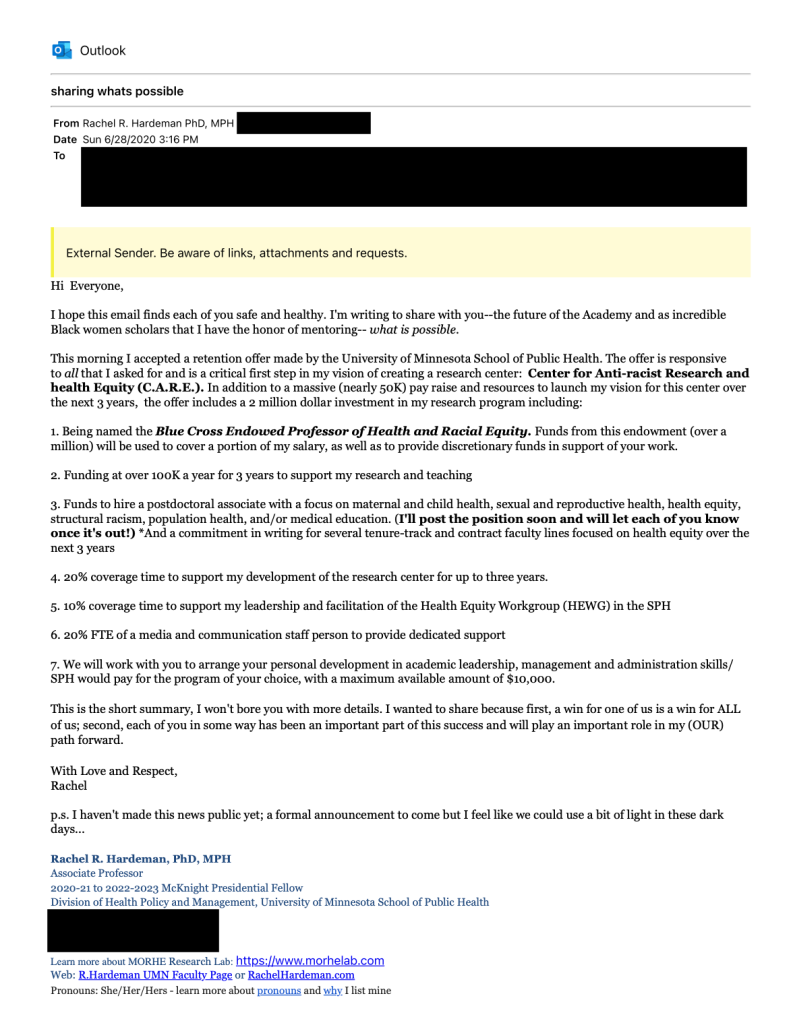
Though their first two submissions didn’t work out, by the time I defended my prospectus in early 2020, they got notice of award on submission #3. I was really excited for them because the work mattered and because it meant a postdoc opportunity on the other side of graduating. A few months later, after George Floyd’s murder, Rachel excitedly emailed a group of us lab members to give us the scoop on her getting funding to establish what would become CARHE:
I had a pretty miserable and traumatic final year in my doctoral program – hurricane, lost funding, and violent institutional interactions. Rachel knew about all of this and seemed like the only one on my side. I finished in spring 2022, and that summer I was hired not as a postdoc but as a Research Scientist at CARHE alongside Brigette, Bert, and eventually Anna. We were excited to do this work under the guidance of someone we admired and trusted. We were excited to center antiracism in our research. The four of us Research Scientists were thrilled at the ability to have a research focused job without any of the political BS of trying to get tenure, especially since we were also promised protected time (20%) for our own research.
Everything in my experience of her seemed trustworthy. She was empathetic in the otherwise cutthroat and violent environment of academia. She had money and she was willing to carve out space and positions for people like me and Brigette whose work and personalities didn’t always align with institutional priorities. I’m thankful for that. But I didn’t realize the immense number of strings that would be attached. And because I had experienced so much institutional violence and neglect, I had no concept of what good mentorship should look like and I mistakenly saw it in her only to realize very quickly that she was just another manifestation of the same problem, but with money, and I was still being exploited.
Set up for Failure
CARHE was a small center. Our staff was also relatively young and freshly out school. All four of us Research Scientists finished our PhDs between 2021-2022. We had three MPH-level research coordinators, a number of graduate research assistants (Rachel’s doctoral advisees and a few masters-level students), and faculty affiliates who were also recent PhD graduates – contemporaries of the Research Scientists. The problem: we had too many projects and not enough staff:
- NIH R01 – aka UP3RISE aka ‘the policing R01’
- Commonwealth Fund grant – aka Bearing Witness
- RWJF P4A grant
- Scholars-in-Residence program aka Ignite the Spark Scholars Program
- Measuring Racism data portal
- C2Dream
- ACOG/CDC
- MN Dignity in Pregnancy and Childbirth
- Multidimensional Measure of Structural Racism
- Health in Her Hue
- An evaluation contract with Hennepin County
- and more…
Our biggest challenge was Rachel’s lack of participation and proper onboarding of us for any of these projects. While we were excited to have some level of autonomy in leading our assigned projects, we expected early mentorship and guidance. Instead, she simply was not involved or communicative in the way she should’ve been. Worse still was she imbued inordinate authority to her Deputy Director (Andre) and Community Engagement Manager (Miamon) where research was concerned. Neither had a research background, which wouldn’t have mattered in their respective positions, except they constantly were involved in research decisions, particularly Miamon. She no doubt helped facilitate the acquisition and set up of many of these grants as one Rachel’s first hires, and she had the most institutional knowledge. But she simply was not trained in or experienced as a researcher and had no business making research decisions.
I was assigned the most work at CARHE hands down. I was to lead Aim 3 of the R01, oversee the entire Commonwealth grant, and co-lead collaborations with Health in Her Hue and the evaluation contract with Hennepin County. The first three were all primary data collection projects, two of which were multi-site projects. One was entirely qualitative and the other was mixed methods, and two had quantitative surveys that had to be designed. All required IRB approval. I was supposed to design, collect, and analyze the data for everything. For reference the Aim 3 of the R01 involved conducting 100 in-depth interviews and surveying 400 people. These were the biggest efforts of her entire portfolio, where everything else was secondary data analysis or had far more PhD-level collaborators involved in the process. I was overwhelmed quickly.
Miamon onboarded me to many of the projects as far as who was who and administrative access, but when I was trying to get answers to research related questions, for some reason I always had to go through her and couldn’t speak with Rachel. This was the experience for other research staff as well. I was on the job almost four months before I ever met with Rachel one-on-one and was increasingly being directed by Miamon. She was at every meeting and on every email, which made sense during a transitional period, but it never stopped. And the grants were confusing – I could not use them as a roadmap because the methods sections didn’t make sense. And on the occasion I could get a meeting with Rachel, she would strangely never answer questions but give excuses for why things were confusing.
Rachel routinely put the Research Scientists (and sometimes her graduate students) in charge of meetings that community partners, Co-Investigators, and funders expected her to lead if not at least attend. She rarely informed them she wasn’t coming, and when she did it was usually ten minutes prior to the start of the meeting, leaving us to field their frustrations and makeup excuses about her lack of presence. Because of the hierarchies of research sometimes these senior scientists would lash out at us, feeling like they could speak to us disrespectfully because we didn’t have their seniority, while really angry at Rachel, who wasn’t there.
I was on the job for 6 months before I realized: we needed to cancel contracts that couldn’t be performed, not accept any new work, and really focus on the R01 and Commonwealth, which were both grossly behind and needed heavy reconceptualizing in order to work. We also needed help. We NEEDED a senior research director, someone with more experience managing all the moving parts that I could and couldn’t see and Rachel didn’t have time. I don’t know what she was preoccupied with, but it wasn’t the center. She kept offering more research assistants and sent me to other early career scholars who didn’t know anymore than I did. But she never stepped up. More comically, this was around the time she gave Miamon, a woman currently working on her MPH, a title change to Director of Research. This would be a huge problem down the line.
Black* Tears
Looking back, it makes me sad that I didn’t feel I could trust my gut. Something was off, but I couldn’t pinpoint what, and everything was happening over Zoom during a pandemic. My first in-person interaction was at IAPHS (academic conference) that fall. It would be my first time meeting most of my coworkers and former MORhE lab colleagues in person. Rachel was uncomfortably emotional, like broke down into sad tears on the first day I ran into her. I thought it was odd, but I don’t know her personal business. One evening Brigette, Rachel, another colleague, and I sat down for drinks. Rachel was again sadly lamenting that she felt like she was failing people and not doing enough, while Brigette and I were both fawning over her, trying to reassure her, saying how grateful we were for the opportunity to work with her after everything we’d respectively experienced over the last year. The other colleague got incredibly serious and told us we had to protect Rachel, and Brigette and I were both confused and both put off. What was that supposed to mean?
We found out later that one of our colleagues had realized at that conference that her work had been stolen. I don’t know if that was the reason for Rachel’s tears that day. But it certainly wasn’t the last time I would experience her and other staff members crying in meetings. A few months later in early 2023, a bomb went off: while Brigette was in the midst of confronting Bert about his issues with plagiarism (I don’t have all the details), she realized her own work had been stolen, and it was an egregious act of plagiarism.
The first aim of the R01 was verbatim plagiarized from Brigette’s dissertation prospectus she’d asked Rachel to review in 2019 before she sent it to her committee. I was shocked, because this was the same grant Rachel and Maeve had been keeping me informed about regarding resubmissions to NIH since 2018. I went back to my Tulane email to find the specific aims page that was sent to me, which would’ve been the second submission to NIH, and the aims were vastly different. The aim that included Brigette’s work wasn’t added until the third submission in early 2020, AFTER she shared her prospectus.
Brigette was devastated and she chose her own timing to let other people know. You can read her account of what happened here. To this day, Rachel claimed it was an oversight, that she always meant to get back around to bringing her in on the project. Yet, Brigette was hired after Aim 1 was completed by Bert and another researcher who was brought onto the project. That researcher stated how she struggled with the analysis and was confused why no one on the team could explain how to do it until she later learned about the plagiarism. If Rachel always meant to pull in Brigette, why would she allow people to struggle with the analysis instead of calling her to help and give her the credit she was owed?
Bert’s plagiarism and then Rachel’s plagiarism, revealed an even more stunning pattern. Brigette had set up a “Turn It In” account for the center, which lets you run documents through a database to determine if they’ve been plagiarized. The intent was to run all manuscripts through it before we submitted for publication to keep the center’s name safe, but she ultimately ran all of our grants through that system, and they lit up like a Christmas tree.
Each grant had several paragraphs that were verbatim copied from other papers, that although she cited, she didn’t even attempt to reword, which is still plagiarism. I finally understood why I couldn’t implement the grants I was in charge of – why the methods sections didn’t make sense. Each paragraph was plagiarized from a different qualitative paper using different methodologies that wouldn’t be used simultaneously, and they were combined into one section. It would be like trying to include directions for making sourdough and focaccia into one recipe – and saying they’re both bread, what difference does it make?
We tried to call her in. Brigette, two junior faculty affiliates (both Black women), and I arranged a phone call with Rachel. Even this was difficult because she was deep into her avoidance of meeting with us. We talked about our concerns for where the center was headed, how work was being rushed and sloppy on one hand, but stalling out on the other because she was never available, we expressed our concerns about Bert, who at this point had co-authored a now infamously retracted paper, which exploited the identities of the two junior faculty on the call, and expressed our concerns about her plagiarizing Brigette’s work.
There was more crying. But before we got off the call, she changed the subject. She informed us that her health was in trouble and that her doctors were urging her to take a medical leave. Instead of us holding her accountable, we were all suddenly trying to console her and encourage her to take a break. We didn’t recognize it then, but later we realized how manipulative this was.
Despite the victim inversion, she did say she would take responsibility for what she’d done at our next team meeting, but that meeting was almost entirely focused on Bert. That paper launched an attack by right-wing groups, and he was being harassed. She spent most of that meeting on camera about to cry, and in the last 10 minutes let the tears fall as she apologized for not creating a safer work environment. She never said what she did, and because we’d spent the past 50 minutes talking about white supremacists, everyone assumed she was taking responsibility for Bert being attacked and they all started consoling her and crying with her. It was a sight to behold.
We confronted her again – told her that she didn’t actually take responsibility for what she did, that the words never came out of her mouth. She stared at us blankly, like she didn’t understand, and insisted she did take responsibility. I repeated back what she said and how that wasn’t an acknowledgment of what she did, so she said she would do it at the next team meeting. She didn’t. And we realized she never would. She couldn’t do it.
Not too long after, Rachel and Miamon texted the four of us, saying it was urgent, and we needed to get on a phone call. Bert was being FOIA’d. Up until this moment we had never been included in center-level issues, even when we should’ve been. Everything was always decided in closed meetings with Rachel, Andre, and Miamon, sometimes Keelia when communications was involved. But Andre wasn’t on this call. If this had been about alerting people who worked with Bert, then the people on the call still didn’t make sense: I never worked with him while Anna, who worked very closely with him, also wasn’t included on the call.
This was about co-opting our good faith attempt at calling her in as a collective. She tried to “sister-girl” us into a false sense of closeness – a phone call of all Black women. The insidious part was two of the women on the call were part of the reason he had to retract the paper, because he (and two white faculty members) told their stories without their consent to get a cheap publication that contributed nothing to the field. The only reason she called the four of us was to derail any momentum for holding her accountable.
This phone call lasted for HOURS, both her and Miamon, crying once again. And then, she essentially asked us to delete our emails with Bert, started talking about how we shouldn’t put anything in writing (or text), how we shouldn’t have anything on our desktops, and how we should preemptively delete any other emails that could be weaponized against us in the future. These are all practices she seems to be employing herself as a recent FOIA request made by Brigette revealed that Rachel has no emails between her and Brigette anymore.
Everything was a manipulation.
Leave & Sabbatical
Rachel made good on the comment about needing to take a medical leave. We set up three 2-hour long meetings with her, Miamon, Andre, the two junior faculty, Brigette, Anna, Keelia, and I about what the transition plan would be for the 3 months she was gone. Those meetings were a complete waste of time. Instead of doing any strategic planning, those meetings were spent with Miamon and Andre accusing primarily Brigette and I of trying to take Miamon’s job from her. We’d raised concerns about the appropriateness of her supervising the research coordinators, all MPH-level, when she was still working on her degree and when their primary job was to be assigned to one of us to move the grants forward. It was creating needless middleman issues.
What happened next was, you guessed it, more tears. Eventually Miamon decided she wanted her effort to be taken off all of the projects Brigette and I were involved in. But as the newly titled Director of Research, what would she then be doing? She wasn’t doing the community engagement work she was originally assigned to – she’d assembled a community advisory board meeting and then went on vacation, leaving me to facilitate that meeting. She never followed up with them. And all of her attempts at “doing science,” were disruptive. On more than one occasion she miscommunicated information to/from Rachel about next directions or communicated what she naively thought should happen next and got the okay. I spent so much time putting out fires and cleaning up messes because she fundamentally did not understand why something need to proceed a particular way. To this day I don’t understand why Rachel gave her so much latitude. She insisted Miamon had research experience, and seeing no evidence of it in her practice, I can only conclude it was because Miamon would “protect” Rachel at all costs and never question her.
Rachel went on leave and the crux of her instructions sent in an email at 11:50 pm the night before she signed off was basically that Andre and Miamon were in charge. She also didn’t effectively communicate to our partners that she was going on leave, and as a result, Summer 2023 was spent navigating endless conflict. The grants were still absurdly behind. The Commonwealth grant specifically needed to finalize a no-cost extension, we had IRB amendments to make, we needed to train people, and we needed to refine protocols. But Rachel was gone and Andre and Miamon were on a power trip. First there was a demand to have full access to our calendars and that we copy everyone on all external emails. Miamon stopped coming to meetings as she said she would, and when the grants accountants needed someone to make the final decisions on the no-cost extension, they called me as the person essentially in charge. This just angered Andre and Miamon even further, who felt like I was overstepping. There was a lot of nonsense that summer, but ultimately, both Miamon and Andre resigned before Rachel returned, and Bert left to work at another center in the University.
Even after Rachel came back, she didn’t resume her responsibilities. I continued being the point person for the no-cost extension and I became supervisor of record for two research coordinators and multiple graduate students. I was doing my job, Rachel’s job, and part of Andre’s and Miamon’s too.
Then came the Ibram X. Kendi exposé of BU’s Center for Antiracist Research (CAR). Many of their staff and affiliates spoke up about what was happening in the center, discussing a hostile work environment, the prioritization of high-profile and revenue generating work instead of research, the inability to finish any of the research studies promised, Kendi’s general lack of availability as he pursued his own speaking engagements and projects, and the callousness with which they were ultimately let go. I was on vacation when that story broke, but a colleague texted the article to a group of us, and to my horror, it was like reading an in-depth look into what was happening in our own center. In retrospect, what happened at BU ended up being the playbook for how UMN eventually treated the few of us left at the center in 2024 – particularly the callous termination.
In the exposé, Saida Grundy, and associate professor and former CAR employee wrote:
“The pattern of amassing grants without any commitment to producing the research obligated to them continues to be standard operating procedure at CAR,” Grundy wrote to Morrison. “This is not a matter of slow launch. To the best of my knowledge, there is no good faith commitment to fulfilling funded research projects at CAR.”
This is exactly what was happening at CARHE. Everything was about appearances first, research second. We were begging for help and instead got pressured to keep things hushed for the sake of Rachel’s health and reputation, and for the sanctity of the field. The whole time she was trying to get her ducks in a row to make her strategic exit.
Before she went on leave #1, she had tried to make Brigette PI of the plagiarized R01 as “reparations,” but Brigette ultimately turned it down in fear that she would lose early career status, and also because the grant was so poorly written and so far behind. In October 2023, Rachel tried to ambush me into becoming PI of the Commonwealth Grant. She made it seem like she was doing me a favor because I was essentially acting as the PI, but the way she did it, announcing it in a meeting instead of talking to me about it privately in the 45 minute one-on-one meeting we’d had the week before, felt like a scam.
It was. In the four months she was back from medical leave, she was already plotting her year-long sabbatical. Despite informing the administrative staff, and hinting to her students and some of our external collaborators, she kept the research staff in the dark. We had some forewarning from partners, and this profile that came out about her in Stat News sounded like a farewell. We emailed her and asked if her if she was leaving and if she was, could she at least have the decency to give us some forewarning. We thought this was an event that would happen some ways down the road. She ignored us for awhile and then hinted at her departure by essentially saying IF we wanted to stay at UMN we would have to do her work. She didn’t officially inform us of her sabbatical until three days before she was due to start it. She claimed the university told her not to tell us.
Several white women faculty were brought in to be the interim director (Michele), interim inaugural research director (Claire), and to sit on a steering committee (Nancy) to determine the next directions of the center. Also, on that steering committee was Jean – the Division chair, a woman she repeatedly and explicitly warned us never to trust. It seemed suspicious that everyone she was leaving in charge were white when so many of our staff meetings involved Rachel and our communications director stressing how the University was out to get the center and no one was to be trusted and they were all racist. She also made one of the junior faculty members, who was part of the group to call Rachel in, an advisor to Brigette, Anna, and I, and had essentially promised one her doctoral students (that Anna mentored/supervised) that she could become the next Research Director after spending the year shadowing Claire.
It was clear to us then that Rachel was “putting us in our place,” reminding us that we were just there to do her work but weren’t worthy of the respect that our demonstrated leadership entailed. The junior faculty member was our academic peer as far as education, but was also 5 years younger than all of us, and had less work experience. The student that we were mentoring was being positioned to be our supervisor once she graduated. Once again weird games of favoritism. Never mind that we had essentially been running the center, looking at budgets, onboarding, training, and off-boarding. Rachel conveniently failed to inform the Commonwealth Fund, who we met with bimonthly, that she was going on sabbatical. She left that dirty work to me, again. I had to tell the Vice President to her face that Rachel was on leave. I finalized the SECOND no-cost extension. But I was disposable.
Death Knell
Rachel’s sabbatical was the beginning of the end. In February 2024, Claire met with each of us (Brigette, Anna, and I) individually to get a handle on what was going on at the center. Apparently there was a lot of chatter going around the institution about CARHE being a disaster, but because Brigette and I were out of state remote, and most of the staff was remote even though in town, we weren’t aware of the whispers. With all of the insults and injury from Rachel, we finally decided to tell Claire everything, and it all blew up from there.
Claire refused to take the position as interim research director, she immediately called all the other interim directors and steering committee, she reported Rachel to the university for plagiarism, and eventually reported her to NIH. An anonymous complaint had been filed in September of 2023, but it didn’t go anywhere. The doctoral student positioned to be the next research director didn’t know about the plagiarism, but once she found out, she backed away. Within a couple of weeks what little leadership structure was set up fell apart. Jean and Kelli (division manager) primarily had to take over, and the warnings to not trust Jean came to fruition.
By March, Brigette resigned. In April, Sirry, one of the co-investigators on the plagiarized grant, along with the other Co-I (Maeve) confronted Rachel about the plagiarism. They hadn’t been made fully aware of what happened until fall of last year when the first anonymous complaint was made and we finally told them. In their conversation, Sirry asked Rachel once again to apologize and take accountability with the staff in an email. When she didn’t, Sirry resigned from the grant, returned her subaward, which made completing the grant even more precarious, and reported Rachel to NIH. There were questions of whether the other co-investigator at Tulane would quit.
By May, Jean informed Anna that she may not have a job by the end of the year.Jean and Kelli had been regularly meeting with Anna and I about moving forward the research. From March to May their sole focus was us completing the grants. We repeatedly asked them if our jobs were in trouble because we didn’t know what was going on with the center. We asked them to be upfront so we could have a CHANCE at finding another position. When she made the statement in one of our meetings that Anna didn’t have enough funding, I immediately suggested she be given more effort on the plagiarized R01 that I was still expected to complete, and that still had another year of funding (expired 3/31/2025). There was surplus money, no talk of canceling the grant, and I needed help.
I told Jean in mid May 2024 that if Rachel would remove herself as PI of the R01, then that would free up more money, especially since she wasn’t currently working on it, and hadn’t worked on it the entire year prior. That would keep both Anna and I employed and capable of finishing the grant. Jean seemed excited at that idea, asked me if I would be willing to takeover as PI (yes), and said she’d speak to Rachel about removing herself from the grant.
The next communication I got from Jean was a notice of non-renewal of my contract, which came while I was on medical leave.
After all of the abuse and exploitation and doing other people’s jobs for so long, my mental health was in the garbage. I took medical leave shortly after that May conversation about changing PIs. I left instructions for the research coordinators, doctoral students, and Kelli for how to move forward on Commonwealth and the R01 for the 3 months I would be out. I started worry about my own job when Anna texted me saying that Jean had randomly put a meeting on her calendar. Rachel called her the night before to warn her that her contract wasn’t being renewed. She was told she’d be employed through the end of the year and that there would be an opportunity for her to extend come January. Jean also said they were exploring opportunities for her to work with other faculty in the Division to get coverage, as well as the possibility of teaching a class.
The next day Jean sent my non-renewal notification by email, two days before the fiscal year was supposed to end. To once again add insult to injury, Anna was offered a better continuation contract. While I also would be terminated at the end of the year, Anna would keep her full salary whereas mine would be reduced to 75% come September. In my email response I asked why there was a discrepancy in our contracts when I historically and presently had more work assigned and still had grant funding? I asked if a decision was made to return the R01 money? I asked why, if there was such a budget shortfall, were efforts made to find other collaborations and opportunities for Anna but no such efforts were made for me?
I never received a cogent response to the discrepancies other than we had different skillsets and they’d look into other opportunities for me at a later day. I never got a response about what was happening with the R01. But the long and short of it is – rather than take responsibility for what she did, and to prevent those NIH investigations from getting completed, Rachel chose to sabotage the entire grant, which eliminated my job and the graduate assistantships (university jobs) for two of her graduate students, which meant they had to scramble to find coverage for the upcoming year in the middle of the summer.
I ended up returning to work earlier than anticipated, because my medical leave was denied: insurance doesn’t cover workplace related injuries (which they deemed the cause of my deteriorated mental health), the irony. Moreover, they determined that because I left instructions for my team, that I clearly wasn’t incapacitated. Punished for being responsible.
I asked Jean for an updated job description because although they wouldn’t tell me what, something had clearly changed, and I certainly couldn’t be expected to do everything I had been doing with less money. That never came. In fact, Jean stopped communicating with me. Kelli, my direct supervisor, also didn’t communicate with me upon returning until she needed me to approve a budget change, and then never again. Rachel, in the entirety of her sabbatical refused to speak to me. If I had questions that needed to be addressed, my Research Coordinator had to contact Rachel so we could get an answer. No one seemed to care what I was doing or whether I was doing anything at all until I informed the program officers at the Commonwealth Fund that I likely would not see the grant through to the end of the project, which of course raised concerns that no one was in charge. Only then did Jean start requesting (softly demanding) that I account for how I was spending my time.
Despite how much Anna and I reported this differential treatment, we were both ignored, and she was specifically told (by Jean) she should just focus on herself. Ultimately, we both quit once the first 3 months were up. Both graduate students secured other funding (and advisors). By December 2024, the Research Coordinator resigned as well. At this point, CARHE is a research center with no researchers. I heard from partners at Tulane that Jean contacted them to tell them the year 4 funding was being returned to NIH; curious that she couldn’t just say that to me seeing as how I was losing my job over it. But as of a FOIA request in early March 2025, the grant was still showing as active with nearly $700,000 unencumbered.
Anti-Black Black People
The racial disparities in how she worked us are stunning. I had an impossible workload and my promised 20% protected time was non-existent. Brigette primarily had non-research activities assigned to her on top of wading through her own distress of the immense betrayal of Rachel’s plagiarism. Meanwhile, both Bert and Anna, both Asian American, had far more flexibility to advance their own careers and were rarely pulled into the work drama. Their time was respected and as a result they had the capacity to publish far more.
“There’s a mismatch between the amount of money that CAR has received from these grants and what they’ve actually produced,” they said. “You can juxtapose that with other research centers either at BU or other universities that have received a tiny fraction of what CAR has received and has produced a lot more.”
Saul, 2023
As expected, little of the data promised was collected, and few papers were published in association with the grants. Although we did complete about 20 interviews in Louisiana for the R01, the survey was never designed, the supplemental analysis was never performed, and Aim 1 of the R01 was cancelled because of the plagiarism. As for the Commonwealth Fund grant, I’m not sure it was ever completed. There were a ton of deliverables, and although two of the three sites had the capacity to collect and analyze all their data, everyone definitely quit at CARHE before data analysis could happen. If those publications ever did materialize, several Black women (PhD student, coordinator, and me) lost out on those opportunities despite the painstaking labor it took to get to the end result.
Rachel has been on a world tour about her research innovations for the last two years with almost nothing to back it up. I’m not sure who’s left that could be working on her much advertised MeasuringRacism Data Portal. She’s spent a lot of time branding herself as someone who, despite experiencing so much institutional abuse, rises from the ashes in service to advancing Black health and loving Black people. But her rhetoric is empty. Her expertise is in DARVO: Denying she ever did anything wrong, Attacking Brigette and I and anyone else who questions her, and Reversing Victim and Offender.
Defamation.
Everything that was wrong with the center was blamed on me and Brigette, but mostly me, because once a complaint was filed about her plagiarism, anything negative about Brigette could be seen as retaliation, and even if she never faced consequences (she didn’t) for the underlying complaint she could get in trouble for retaliating. So I caught the brunt of her blame.
- When Rachel was questioned about why Bert left CARHE to work at the Minnesota Population Center she said it was due to conflict he had with me and Brigette. I didn’t work with him.
- When Sirry confronted Rachel in early 2024 about the plagiarism and asked why everyone was quitting , Rachel suggested that people were left because of me and Brigette. That Miamon would come back if we quit. Moreover, she said that I specifically was “rude,” and that we all just wanted her to “fall on her sword.”
- Claire was warned about me and Brigette – was told we were “difficult to work with,” and she heard from other faculty that they’d been told that we created a hostile work environment.
I’m no stranger to being portrayed as a racial stereotype – I’ve grown up in predominantly white spaces and attended predominantly white schools. But when Black women call other Black women angry, or jealous, or difficult, there’s a level of credibility and weight behind it that doesn’t exist when white people say it about Black women. Black people wouldn’t leverage a racial trope unless it were true, right? The worst part about it, is these statements were made about me to primarily white audiences, other faculty, staff, and people in their networks who I would never meet because I were remote. Everyone knew Rachel and Miamon, they were pleasant and likable. Who was I?
But if I was such a terrible person to work with, if I was as rude and angry as they made me out to be, why was I trusted to functionally act as the PI of two complex multi-site grants worth millions of dollars? Why was I entrusted to meet REGULARLY with the program officers at the Commonwealth Fund? Why was I sent to represent the center at grantee meetings among other PIs? Why was I the point person for negotiating the terms of two no-cost extensions or signing off on progress reports and NIH RPPRs? These were her responsibilities.
I supervised and trained students, temp workers, and research coordinators, made sure people got hired and paid, I wrote and rewrote and redesigned protocols after realizing the grants as written couldn’t be performed, I was overseeing the IRB applications, designing data collection tools, coming up with data management systems, and trying to make sure sensitive information wasn’t just sitting in google drive like everything else in the center where any and everyone had access. I was also mentoring HER graduate students, and trying to protect the rest of the research staff from being overburdened. We kept her research enterprise running for 18 months while she was off collecting honoraria and awards talking about her pain and her innovation. But I’m the asshole?
The other part of this that’s so difficult to swallow is I was navigating all of this AND trying to manage the secondary trauma of the research itself. The interviews we collected were hours spent on zoom and sometimes in people’s living rooms listening to Black women describe in detail the murders of people they loved, their incarceration experiences, their children who never made it out of the hospital because of medical racism, the fears they had for their siblings and young children navigating the violence in the city, and the potential for police sexual and physical violence. Those were the tears and stories that mattered, not Rachel’s. That was the work. She asked us to go out into the world and collect these stories for research and yet, to this day they sit languishing in some untouched digital storage folder. Absolute violence.
In the seven years I’ve known her she has:
- plagiarized several works
- derailed trajectories – Anna, Brigette, and I had other opportunities we turned down to work for CARHE
- ghosted her graduate students that she recruited leaving them to scramble for funding and mentorship
- defamed our character leaving us in perpetual fear that given her stature and network we would struggle to find other opportunities in the field
- financially destabilized us: Brigette and I both suddenly had to scramble for jobs that paid a fraction of what we were making – lost retirement matches – setbacks impacting us to this day especially in THIS job market with all of Trump’s cuts
- mentally destabilized a rather large cohort of scholars of color – at least 10 women I can name offhand – who not only question whether to trust Black women who we’ve cited and admired, but whether to affiliate with health equity and antiracism work at all
- sabotaged the entire center because she would rather preserve her image as a savior than simply admit to what she did to the staff and research team and apologize – that is ALL we ever asked her to do.
In her own words she stated, “It’s not in my nature to show up and be the angry Black woman.” But it seems like it’s not in her nature to show up at all, unless it centers her. I hate that there are so many of us hellbent on proving that we’re “one of the good ones.” There was no reason to ever make this statement except to signal safety to white liberals.There’s value in anger, it means you’re present and alert to what’s happening in the world. I don’t know how you work on police brutality and Black maternal deaths and all of the other manmade issues at the center of our public health research without being angry. That anger fuels innovation, and maybe that’s why she doesn’t have anything to contribute, and why she steals other people’s ideas, labor, and competence.
A Center Without Research
The only thing going on at CARHE right now is the continued work on the MeasuringRacism Data Portal by outside researchers that Rachel will no doubt take credit for, and the RWJF funded Ignite the Scholars program. Even though there are many people who know what Rachel has done – she’s been reported to the University with no consequences, she’s been reported to NIH without result, and people who have withdrawn collaborations with her – she’s ultimately gone on with her life unscathed.
In fact, it would seem like she’s doing better than ever. In the two years since she began terrorizing a collection of junior scholars of color, she’s been promoted to full professor with a raise, she’s been named Time’s 100 Most Influential people in 2024, she’s been a speaker at Aspen Ideas, she’s been quoted in fiftyleven articles and profiled multiple times in feel good/savioristic pieces, she’s been awarded multiple honors and fellowships, she’s regularly invited to be a keynote speaker, she’s been added to at least one notable board of directors, and she’s financially profited off of all of this on top of her salary.
Rachel could’ve taken responsibility for this back in Spring 2023 when we first called her in. We asked for a research pause, we asked for an in-person strategic planning meeting, we asked for senior leadership. We could’ve course corrected and improved upon what should’ve been an extremely innovative and productive community-engaged research center. The money and opportunity was there. But she let her cowardice, insecurity, and ego prevail.
I’ve never had much faith that shed’d ever take responsibility for what she did, let alone take the steps towards restitution. Now with this choreographed and public resignation from the university and CARHE, I’m certain she won’t. She chose to try and outrun the negative press, and gave herself a hefty head start with all the secretive sabbatical planning and caginess.
She worked us up into believing that our silence was necessary for the sake of the collective. But she is not the field, and telling the truth about her doesn’t mean the end of health equity or antiracism research. The work was getting done before her, it was happening without her while she was on her press tours, and it will continue long after she’s gone.
I don’t wish good or bad things for Rachel Hardeman, I just wish she would go sit down somewhere.
*Updates*
Several media articles came out after I blew the whistle. Articles mostly focused on the plagiarism and not the overall pattern of fraud, abuse, and neglect, but a couple of smaller outlets did report on the bigger picture, and one even got Rachel to show her true colors:
“Everywhere you go there are disgruntled employees.”
Ryan Quinn reporting on what Rachel Hardeman said about me, Inside Higher Ed
Hardeman said there’s a strong feeling of scarcity in academia that gets “weaponized,” and there are people who can’t “reconcile my visibility with their own sense of scarcity.”
“I wasn’t just doing the work, I was the work, and for some people I suspect that that was hard to reconcile,”
One MPR article managed to get ahold of her separation agreement, which is an interesting read, as well as her final report on the plagiarized grant to NIH. If MPR had given any thought to doing anything other than being first to publish, they might have asked us to look at that closeout report and provide a comment, because this report is an egregious fabrication.
I annotated the lies on the document linked above. It’s a long document, but only the first 8 pages matter. The TL;DR though is that Rachel is a skillful, artful even, liar – and you’d have to know so many details to understand how intricately woven her web of lies is.
- Important context: NIH has pre-formatted reporting documents that are usually completed by a grants manager using prior approved documents over the life of the grant. The PI will fill in any new information, including research specific accomplishments
- Rachel wrote section B2 and B4 – and from JUMP you can see that she revised the grant aims from what is reported on the page filled in by the manager. Why?
- She changed the aims to make it seem like more was accomplished than was – sleight of hand.
- Now that you’re focused on these new aims, Aim 3 in this revised list was NEVER part of any discussion we had or any work we did. She made this up entirely.
- And Aim 4, which she’s alluding to as the “attribution concern” aka the plagiarism, is another trick. The mixed methods work we were supposed to do was a survey of nearly 400 women in two cities compared against the interviews – this had nothing to do with Brigette’s work or Rachel’s plagiarism which is entirely in Aim 1 of the ORIGINAL aims list (on page 2)
- Most of the accomplishments are twisted lies:
- we did not develop and did not plan to develop a framework grounded in reproductive justice
- the issues with recruitment in Minneapolis were entirely about understaffing
- her dissemination in Cape Town & Austria were entirely personal trips aka vacations she took using either grant money or endowment funds to the tune of $6-$7K. She gave a talk, but it was the same talk she always gives and had nothing to do with this grant because WE DID NOT HAVE RESULTS!
- The results she lists are conveniently vague & generic. No data analysis happened and I know she didn’t read the transcripts. I conducted most of the interviews myself, and her summary is nothing more than blanket statements that could’ve been derived from anyone’s study or anyone’s guess about what our participants would’ve said. The statement about Black birth workers though, was pretty much never brought up by the women we spoke to – she clearly wanted that to be an outcome to align with her other research, but it was not
- Only 2 of the 5 peer-reviewed papers she lists as coming from this grant actually did. The rest were papers having to do with policing that she just happened to be included as an author on. Given how little she contribute to the paper I’m a co-author of, I doubt she contributed materially to the other ones she’s claiming.
For more reading:
- Influential U of M public health professor resigns amid plagiarism allegations (MPR)
- U of M accused of mishandling plagiarism allegations against influential professor (MPR)
- What a Fucking Mess (Medium Article)
- The Frustrating Case of Rachel Hardeman (Plagiarism Today)
- U of Minnesota Antiracism Center to Close After Founder Steps Down (Inside Higher Ed)
- U of M shuts down research center plagued by plagiarism allegations (MPR)

 like black butterflies
I work in a Health Equity institution and I experienced eerie similarities to the story you just described. Just reading this made me sick to my stomach on your behalf and brought back a lot of memories. For what it’s worth, you’re not alone.
I really respect and appreciate the care you took to detail all the opportunities and strategies you tried to make this right with the PI. Working in racial justice you are already fighting uphill to get funding, respect, and traction with your work, managing the micro and macro aggressions of racism (towards your community partners AND the research team…) and dealing with the secondary trauma you described. We see and hear so much, balancing it all on top of the BS and politics of universities…. it’s easy to bottle up because as you say the field is under direct and vicious attack.
Thank you for your truth and your role as a cycle breaker. I pray for your healing of mind and soul
LikeLiked by 1 person